
Natural rubber (NR) remains a vital raw material for tires, industrial goods, medical products, and consumer goods. Demand has grown steadily in recent years, but production cannot keep pace. Global output is inching up – ANRPC projects only a 0.3% rise in NR production for 2025 – while demand is surging (~+1.8% forecast)euronews.com. Major producers like Vietnam and Indonesia have seen output declines, Thailand only modest gains, and even new sources like West Africa cannot fill the shortfallreuters.com. The result is a persistent gap: for the fifth consecutive year, production is expected to fall short of consumptioneuronews.comfinshots.in. This structural deficit keeps prices volatile and high, despite occasional corrections (e.g. futures dipped ~4% in early 2025euronews.com).
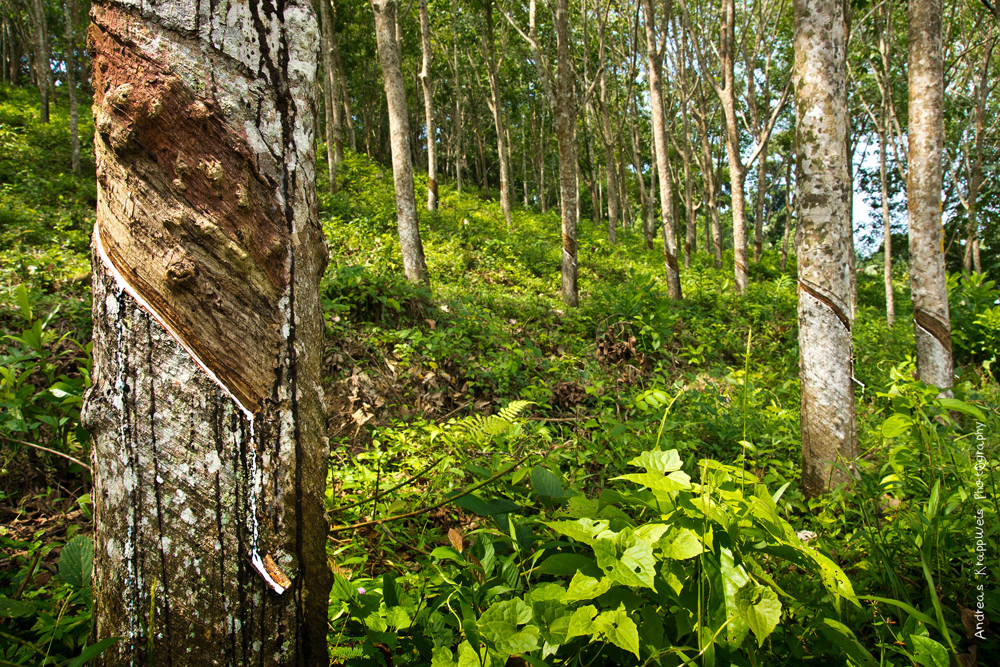
Rubber production is dominated by Southeast Asia (over 75% of global supplyfinshots.in) and constrained by biology – Hevea trees take ~6–7 years to maturefinshots.in. In the past decade low prices dissuaded replanting, so when weather or disease hit (e.g. Pestalotiopsis blight in Indonesia, heatwaves in Thailand) the impact on harvests has been acute. For example, Thailand’s rubber output fell ~10% in 2024 and Malaysia’s was down 9.2% early 2025everstream.ai. Even positive monthly gains (e.g. Malaysia +5.9% in June 2025temasekpost.com) have not offset year-on-year declines. Countries like China and India are boosting demand (China’s rubber imports jumped +23.5% in early 2025rsglove.com), widening the gap. In India, production (~0.86 Mt in 2023–24) covers only ~60% of consumption (~1.42 Mt)finshots.in, forcing ~40% import dependency. New planting (e.g. in India’s northeast) and productivity drives will help, but with each rubber tree taking years to yield, the supply-demand deficit is likely to persist in the near termfinshots.infinshots.in.
Summary of sustainable/bio opportunities:
- Alternative rubber crops: Guayule, Russian dandelion, and other plants that can grow outside the tropics are being developed, reducing climate riskbridgestone.com. Early tests have yielded consumer goods (e.g. gloves) made from guayule latexbridgestone.com.
- Tire recycling/circularity: New chemical recycling (KAIST) and expanded pyrolysis promise to recover rubber and carbon-black from scrap tiresphys.org. Scaling these could relieve raw material pressure.
- Recycled contents: Large tire and auto-part producers are rapidly increasing recycled polyester, steel, silica, and carbon black in productscontinental.com. This not only cuts emissions but can stabilize supply.
- Bioplastics: The PLA plant in Indiabioplasticsmagazine.com and global biopolymer rollouts (bio-PET, PHA, etc.) illustrate how plastics supply chains can shift to renewable feedstocks. Regulatory drivers (e.g. bans on some single-use plastics) further spur adoption.
Each of these trends – bio-rubbers, circular recycling, bio-polymers, higher recycled content – presents a business opportunity. Companies that innovate in these areas can gain first-mover advantages in evolving markets. For instance, using rice-husk silica or latex from sunflower-derived polymers can differentiate tire products on eco-credentials. Startups offering on-site rubber recycling or blockchain tracing for rubber origin can find eager buyers among sustainability-minded firms.
Do not compromise on quality or cost. Partner with Raj Industries for your next high-performance component project. Our deep material expertise, advanced manufacturing capabilities, and commitment to ISO 9001 quality ensure your designs are translated into reliable, high-precision plastic and rubber parts. Contact us today to discuss your specific requirements
and Request a Quote or Whatsapp